
Recipe: flatbread for a holiday trip
Are you planning to go on a roadtrip and still want to eat fresh, tasty and reasonably healthy gluten-free bread every day? Quite tough if there isn’t a decent gluten-free bakery nearby. In many countries, the range of gluten-free bread in supermarkets is a real let-down – if you can even find any bread at all. At best, you’ll find gross, starchy bake-off rolls. In other words, you’re doomed to go without bread or choose other foods instead.
This summer I tried out my flatbread recipe on our camping trip through Europe. As far as my 14-year-old son with coeliac disease is concerned, it was a huge success. OK, the recipe contains a third starch, so it could be healthier, but given how convenient it is on holiday, I think it’s a fair trade-off. Especially when you realise how fluffy, delicious and versatile these breads are.
The minimum you need is water, a camping stove, a pan, a digital scale, a bowl and a flat surface (plate/chopping board). Lightweight and compact or big and heavy equipment, it doesn’t matter. The rest can be done by hand. If you’ve got space to spare in your luggage, take a whisk and a silicone spatula with you. Handy, but not essential.
Prepare the flour mix before you go on holiday, mix it well and put it in a zip-lock bag or a tightly sealable container. All you need to do when you crawl out of your tent is mix some flour with water, shape the dough balls into flat discs and fry them briefly over a high heat. A lovely morning ritual right outside your tent. And just look at those envious glances from the other campers! The recipe is also suitable for hikers heading into the mountains with minimal kit.
Flour mix, makes at least 13 flatbreads (f=fibre, p=protein)
100 g potato starch
50 g white rice flour (f1, p7)
50 g oats (f9.3, p12)
50 g white teff (f7.9, p12.3)
50 g sorghum (f9, p12)
10 g baking powder
25 g very fine, highest quality psyllium powder (f88, p1.4, 99% purity, 100 mesh)
10 g iodised salt
Optional: dried herbs, such as oregano and rosemary
Don’t forget to pack a little bag of white rice flour for dusting.
You can, of course, experiment with the proportions of the flour mix or use other ingredients. In my recipe, you use 75 grams of water to 50 grams of flour; always test for yourself whether the amount of water is right. That’s smart anyway, as your psyllium and flours are always different from mine. Compare the fibre and protein content of my varieties (especially the psyllium) with yours, treat the recipe as a guideline and adjust the quantities (by feel). Make sure the hydration remains high (at least 150%), to create the fluff.
For 2 flatbreads:
– Take 50 grams of flour and mix it thoroughly with 75 g of (sparkling) water, using your hand or a whisk, until there are no more lumps. This is where you could also add tiny bits of onion, garlic, cheese, peppers, herbs etc.
– If you have some to hand, add 5 g olive oil and mix once more.
– Wait a moment until the psyllium has absorbed most of the water, scrape the edges with a spatula and then roughly divide the dough into two pieces. Shape into two balls with oiled hands. They should feel very soft, malleable and slightly damp to the touch.
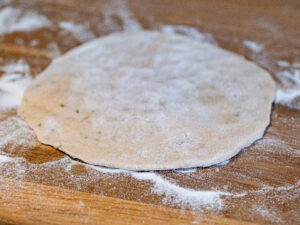
– Dust a flat surface with white rice flour and gently press the dough ball out with your fingertips into a flat disc of 16–18 cm. Take it slow, because it’s easy to tear the dough (but fortunately also to repair it). Turn it regularly in the rice flour so that it doesn’t stick to the surface. Use a little more rice flour if the dough remains damp, but not too much, as this will make your flatbread hard and dry. Keep it clean or sprinkle with some sesame, poppy, nigella seeds or other good stuff.
– Set the stove to 75% of the maximum, heat a tablespoon of oil in any pan and wait until the oil starts to smoke. Your aim is to fry the dough briefly at a high heat, so that it becomes nice and light. If the temperature is too low, the flatbread will be too thin, but if you fry it at too high a temperature, it may burn slightly. Find the sweet spot.
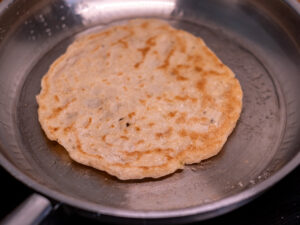
– Put the dough into the pan and count to 20. Flip it over, then count to 20 again. In theory, it should be ready by then, but cook for a bit longer if needed. The flatbread should have a rocky surface like the moon and at least 0.5 cm thick in the spots where the dough has expanded the most.
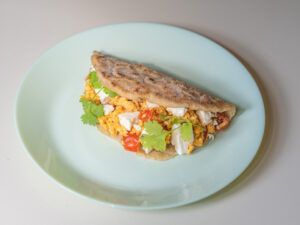
– Remove from the pan and fill with something tasty. For the photo, I’ve gone for a Mexican-style breakfast, with scrambled eggs, cumin, chilli, lime zest, tomato and coriander.
Good luck and enjoy!